Origin story and journey of
Tea /Chai / Cha/ Muo Cha

Before we talk about the origin of tea. we have a story of the mythical Chinese inventor of agriculture Shennong .During a long day spent roaming the forest in search of edible grains and herbs, the weary divine farmer Shennong accidentally poisoned himself 72 times. but before the poison can end his life a leaf drifted into his mouth. He chewed on it and it revived him , and thet is how we discovered tea.Or so an ancient legend goes at least. Tea doesn't actually cure poisonings, but this story highlights tea's importance to ancient china.Archaeological evidence suggests tea was firstly cultivated there as yearly as 6000 years ago or 1500 years before the pharaohs built the great pyramids of Giza.The original chinese tea plant is the same type that was grown around the world today yet it was originally consumed very differently . It was eaten as a vegetable or cooked with grain porridge. Tea only shifted to food to drink at 1500 years ago .

Origin story of tea in china
A great deal of legend and myth surrounds the story of the origin of tea. One legend says that, in the year 2737 BC, the Chinese Emperor Shen Nung noticed that a green leaf had blown into a bowl of boiling water, colouring the water and creating what became known as tea. From then on the emperor desired nothing but tea to drink. they are also draw extravagant pictures in the form of tea, very much like espresso art you might see in coffee shops today .

The Invention of Black Tea
Japan's Tea History
In the early 9th century, Japanese visitors to China were introduced to the values and traditions of tea. The Buddhist monk Dengyo Daishi is credited for bringing Chinese tea seeds to Japan when he returned from his studies abroad. Tea became an integral part of Japanese monastery life; monks used tea to help stay alert during meditation sessions. By the early 1300's tea gained popularity throughout Japanese society, but its early religious importance permanently colored the meaning and value the Japanese associate with tea and directly influenced the Japanese Tea Ceremony.
Russia's Tea History
In 1618, the Chinese presented a gift of tea to Tsar Alexis of Russia. Everyone was curious about the new beverage and tea quickly gained popularity. A camel caravan trade route emerged to transport tea into the country. This caravan covered 11,000 miles and took nearly 1½ years to travel by camel. To keep the tea-hungry Russians satisfied, nearly 6,000 camels - each carrying 600 pounds of tea - entered Russia each year. In 1903 the camel caravan was replaced by the famous Trans-Siberian Railway, which slashed the transportation time from 1½ years to just over a week.
In 1618, the Chinese presented a gift of tea to Tsar Alexis of Russia. Everyone was curious about the new beverage and tea quickly gained popularity. A camel caravan trade route emerged to transport tea into the country. This caravan covered 11,000 miles and took nearly 1½ years to travel by camel. To keep the tea-hungry Russians satisfied, nearly 6,000 camels - each carrying 600 pounds of tea - entered Russia each year. In 1903 the camel caravan was replaced by the famous Trans-Siberian Railway, which slashed the transportation time from 1½ years to just over a week.
Europe's Tea History
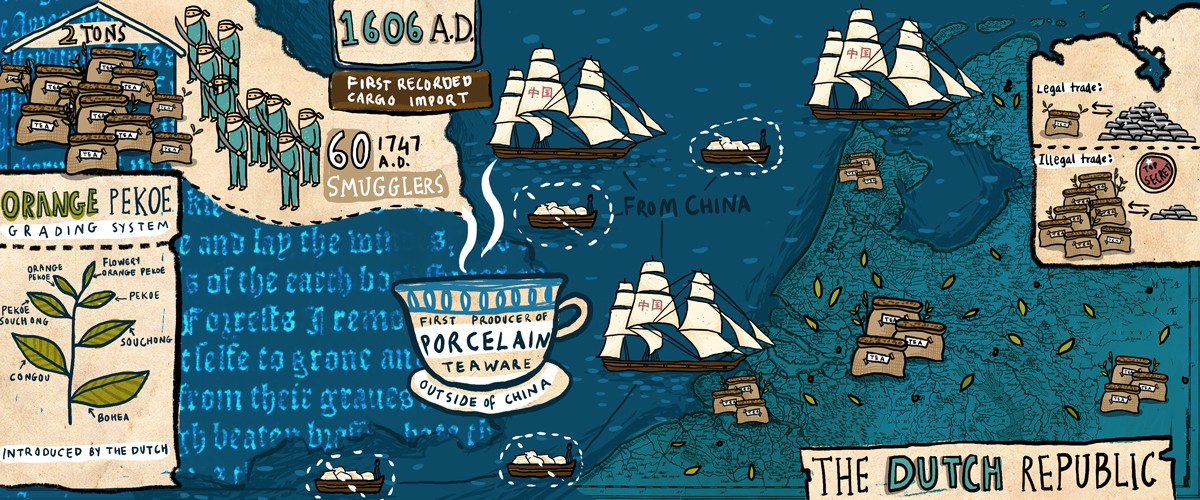
The Portuguese and Dutch first imported tea into Europe in 1610...Rembrandt was just 4 years old! England's dance with tea did not start until 1662 when King Charles II married the Portuguese princess Catherine of Braganza. Britain's new Queen had always loved tea and brought with her, as part of her dowry, a chest of fine Chinese tea. She began serving the tea to her aristocratic friends at Court, and word of the exotic Royal beverage spread quickly.
Tea as a Status Symbol
As an imported luxury, only the wealthy could afford to drink tea. The least expensive pound of tea available cost the average laborer about a month's worth of wages. The lofty tea prices made tea highly fashionable and elitist. The ability to serve and drink tea with elegance and skill marked social status and indicated good breeding and intellect. To that end, many wealthy 18th century English and Dutch families had paintings made of the family having tea.
The "Afternoon Tea"
Afternoon tea, still a popular British institution, is credited to Anna, the 7th Duchess of Bedford , who complained of the long gap between a light breakfast and a late evening meal. To appease her cravings, she advised her maid to bring a pot of tea and light refreshments to her room. Anna soon began to invite friends to join her for afternoon tea...and the trend spread quickly.
 |
| Afternoon Tea by George Goodwin Kilburne |
The "High Tea"
High tea is a very much a different thing than the Afternoon tea. High tea, though it sounds more elite, is actually a 19th century working class custom. High tea is served later (around 6:00 PM) and consists of a full dinner meal for the common people. High tea is served alongside meats, fish or eggs, cheese, bread and butter, and cake. High tea is more of a man's meal, while Afternoon tea is more of a lady's social diversion.
The role of tea in globalization
The Dutch dominated the tea trade until 1678 when the British began importing tea on a commercial scale. The British Royal family, seeking full control and profits over trade, chartered the East India Company and granted it a monopoly on all trade throughout Asia and Eastern Africa. The East India Company quickly became the most powerful monopoly the world has ever known - and tea was its primary commodity. They were given the right to acquire territory, coin money, keep armies and forts, punish lawbreakers, form foreign alliances, and even declare war.
The reign of the East India Company continued until the British Parliament declared the trade routes open to competition in 1833. There were, however, many lasting effects of the centuries of dominance. The British East India Company changed the world: They claimed Hong Kong, Singapore, and India as British colonies, and prompted a global economy...all because of tea.

India's Tea History
India is the world's largest consumer of tea in the world – and the second largest producer of tea – including the world's most popular tea varieties - like Assam and Darjeeling tea. However, the growth of tea as an industry in India has been relatively recent.
Historical records indicate the prevalence of tea drinking in India since 750 BC. In the 16th century, a vegetable dish was also being prepared using tea leaves with garlic and oil. However, the credit for rediscovering tea and cultivating it at a commercial level goes to the British.
Tea Cultivation was commercialized by the British in India
Commercial tea cultivation in India was driven by British who consumed tea in enormous quantities, which they bought from China. By 1750, they were purchasing millions of pounds of tea every year from China. Even though the British managed to counterbalance it with opium trade to some extent, they found that their tea consumption was exorbitantly expensive and unsustainable.
Commercial tea cultivation in India was driven by British who consumed tea in enormous quantities, which they bought from China. By 1750, they were purchasing millions of pounds of tea every year from China. Even though the British managed to counterbalance it with opium trade to some extent, they found that their tea consumption was exorbitantly expensive and unsustainable.

This realisation led to a sustained effort by the British to understand tea production – and start tea cultivation in India.
Tea Producing Regions of India
 Following the success of tea cultivation experiments in Darjeeling and Assam in the 1800's , Eendeavours in other parts of India with similar natural conditions were undertaken. These efforts led to a thriving tea industry in at least ten distinct tea producing regions of North-East and South India:
- Darjeeling
- Assam
- Dooars and Terai
- Kangra
- Nilgiri
- Annamalais
- Wayanaad
- Karnataka
- Munnar
- Travancore
Different Tea Varieties in India

 Darjeeling has been growing the Chinese variety of the tea plant since 1841. But unlike other regions that grow this variety, the environment of Darjeeling has a unique and magical effect on the tea bush. Part of this magic can be explained by science, and part of it remains an endearing mystery. Darjeeling tea is sold at very high premiums in the international market due to its Muscatel flavour (or a musky spiciness). This flavour cannot be replicated in any other market because Darjeeling tea has a geographical indication .
  Tea plantations in Darjeeling are situated at altitudes between 600 metres and 2,000 metres above sea level. The soil, the intermittent clouds hovering above the mountains and the bright sunshine - all contribute to the magic of Darjeeling tea. Plucking Darjeeling tea leaves is a slow, exacting and time consuming process.
Assam Tea
The state of Assam (name derived from Asom, meaning one without equals), which includes the northern Brahmaputra valley, the middle Karbi and Cachar hills and the southern Barak valley, is home to the single largest contiguous tea growing region in the world.
Assam is also home to India's largest tea research centre, which is located at Tocklai in Jorhat, and is managed by the Tea Research Association.
Dooars and Terai Tea
The first plantation in Terai was named Champta, and it was set up by James White in 1862. Subsequently, the Dooars region saw its first tea plantation in the form of Gazeldubi. In Dooars, the Assamese tea plant was found to be more suitable.
Today, Dooars and Terai have a combined annual production of 226 million kg of tea, which accounts for around 25% of India's total tea crop.
Today, Dooars and Terai have a combined annual production of 226 million kg of tea, which accounts for around 25% of India's total tea crop.
Kangra Tea
 The Kangra district in Himachal Pradesh was deemed as a potential tea growing region by Dr. Jameson in 1829, following a feasibility survey. He brought Chinese tea plants from Almora and Dehradun and had them planted at Kangra, Nagrota and Bhawarna.
The Kangra region is famous for its range of green teas (Hyson, Young Hyson and coarse grades) and black teas (Pekoe, Pekoe Suchong, Coarse teas and Fannings) and are globally renowned for their exquisite flavour.
Nilgiri Tea
 Initial experiments with tea cultivation commenced in the Ketti Valley in 1853, and commercial production was first undertaken in the Thiashola and Dunsandle Estates in 1859. Over a century later, Glensmorgan emerged as the first estate in South India to produce green tea in 1969.
Nilgiri tea has also been registered as a GI in India, and around 92 million kg of this tea are produced every year - around 10% of India's total tea production.
Types of Tea
Four main types of tea are produced based on how tea leaves are processed2:
- Green tea (non-fermented)
- Black tea (fermented)
- Oolong tea (partly fermented)
- White tea (least processing)
All four types of teas - i.e. green tea, black tea, oolong tea and white tea - are made from the same tea plant, Camellia Sinensis (L) O. Kuntze. How the tea ends up depends on how it is processed2 after being picked.
White tea undergoes the least processing, followed by green tea (non-fermented) and oolong tea (partly fermented). Black tea (fermented) is made to go through an oxidation process, to which it owes a distinctive flavour.
White tea undergoes the least processing, followed by green tea (non-fermented) and oolong tea (partly fermented). Black tea (fermented) is made to go through an oxidation process, to which it owes a distinctive flavour.
Green tea is made by withering tea leaves - and then steaming, rolling and drying them. It undergoes minimal processing, and contains 80-90% catechins and flavonols (10% of total flavonoids). The infused leaf is green, and the liquor is mild, pale green or lemon-yellow.
Black tea involves additional processing (i.e. aeration and withering). As a result, it has different levels of catechin (20–30%) and flavonoid content (theaflavins and thearubigins represent 10% and 50–60% of total flavonoids respectively).
Black tea is by far the most common type of tea produced. The infused leaf has a dark brown colour and a sweet aroma.
Oolong tea is a partially or semi-fermented tea. A full-bodied tea with a fragrant flavour and sweet fruity aroma, it has some qualities of both black tea and green tea due to its manufacturing process. It is more suitable for people who prefer a low caffeine option.
White tea is appreciated by tea connoisseurs for its unmatched subtlety, complexity and natural sweetness. It is also considered to be a far greater source of antioxidants than green tea because the tea leaves undergo minimum processing.
- All four types of tea contain different types of polyphenolic compounds with antioxidant properties. So all the four types of tea are good for health. However, due to a difference in their nutrient content, they offer different health benefits.

Wow😍
ReplyDelete